
Tying or Tieing: Which Spelling Should You Use?
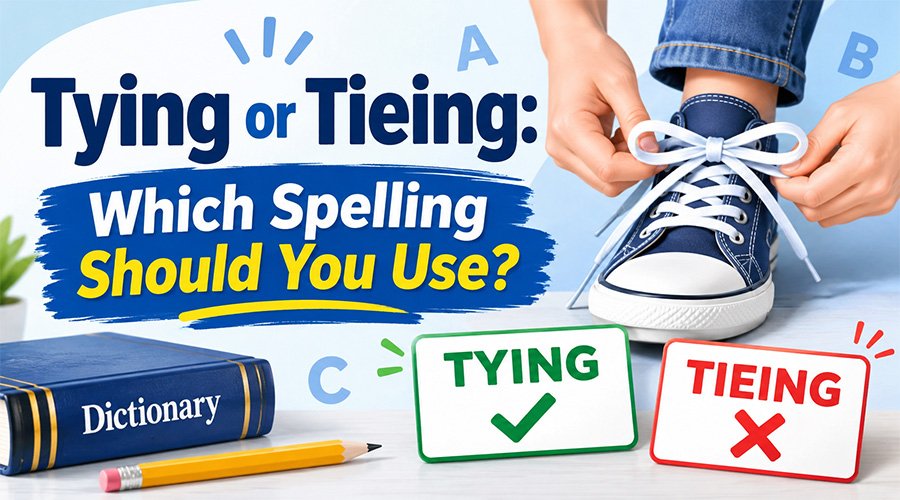
Many people get confused when deciding whether to write tying or tieing. Both spellings may look correct, but only one is commonly accepted in modern English. The choice between Tying or Tieing is a common example because both forms appear logical at first glance.
The original verb is tie, so adding -ing might seem like it should produce tieing. However, standard English uses tying. The difference comes from a spelling rule that changes the final letters of certain verbs before an ending is added.
Is It Tying or Tieing?
Tying is the correct standard spelling, while tieing is generally considered a nonstandard form in modern English.
Tying is the present participle of the verb tie. It describes an action involving fastening, connecting, or securing something. It can also function as a gerund when the action is used as the subject or object of a sentence.
For example:
- She is tying her shoelaces before going outside.
- The shopkeeper is tying a ribbon around the gift box.
- He enjoys tying fishing knots during his free time.
- Tying the two ropes together requires some practice.
All these sentences use the same spelling, regardless of the situation.
| Word | Status | Usage |
| Tying | Correct | Present participle of tie |
| Tieing | Nonstandard | Generally avoided in modern writing |
| Tie | Correct | Original verb |
| Tied | Correct | Past tense and past participle |
| Ties | Correct | Third-person singular |
For schoolwork, professional communication, and published content, tying is the appropriate choice.
Why Is Tying Spelled With a Y?
The reason comes from a specific English spelling convention. When a verb ends in -ie, its final two letters change to -y before adding the suffix -ing.
This produces a different spelling from the one many writers initially expect.
The transformation is:
Tie → Tying
The original verb “tie” changes to “tying” when the -ing suffix is added.
The same convention applies to several other verbs. Instead of memorizing every word separately, you can learn the pattern and apply it when needed.
Consider these examples:
| Original Verb | Correct -ing Form |
| Tie | Tying |
| Die | Dying |
| Lie | Lying |
| Vie | Vying |
| Untie | Untying |
This spelling convention is also documented in The Canadian Style, which explicitly lists tie becoming tying alongside die becoming dying and lie becoming lying.
What Does Tying Mean in English?
Tying means fastening, attaching, or securing something using a knot, string, rope, ribbon, or another suitable material. The word comes from the verb tie and is commonly used in everyday conversations and written instructions.
Its meaning can also extend beyond physical objects.
Here are four common ways the word is used:
1. Fastening objects
This refers to connecting items with a knot or similar method.
Example: She is tying the ribbon around a birthday present.
2. Securing something
It describes keeping an object in a particular position.
Example: The sailor is tying the boat to the dock.
3. Equalizing a score
In sports, tying means bringing two competing scores to the same level.
Example: The home team is tying the match in the final minutes.
4. Connecting ideas
The word can describe establishing a relationship between different subjects or events.
Example: The professor is tying the historical events to modern developments.
Although the meaning changes with the context, the spelling never changes.
Tying vs. Tieing: Examples in Everyday Sentences
Seeing both spellings side by side makes the difference easier to recognize. The following examples cover situations involving clothing, household activities, sports, and general communication.
| Incorrect | Correct |
| She is tieing her shoes. | She is tying her shoes. |
| He is tieing a knot. | He is tying a knot. |
| They are tieing the packages. | They are tying the packages. |
| I am tieing my hair. | I am tying my hair. |
| The players are tieing the score. | The players are tying the score. |
| He is tieing the rope to a tree. | He is tying the rope to a tree. |
Here are additional examples showing natural uses of the word:
- The children are tying colorful ribbons around their handmade cards.
- Before starting the journey, the driver checked the ropes tying the luggage to the roof.
- My father taught me the correct method of tying a fishing hook.
- She was tying her hair when the phone started ringing.
- The two teams are tying after a closely contested match.
These sentences demonstrate how the word fits into different grammatical situations without changing its spelling.
What Is the Difference Between Tying, Tied, and Tie?
Although these words come from the same verb, they serve different grammatical purposes. Choosing the right form depends on the tense and structure of your sentence.
| Form | Grammatical Use | Example |
| Tie | Base form | Please tie the package. |
| Ties | Third-person singular | She ties her hair every morning. |
| Tied | Past tense | He tied the rope yesterday. |
| Tied | Past participle | The package has been tied securely. |
| Tying | Present participle | She is tying her shoes. |
| Tying | Gerund | Tying knots takes patience. |
Notice that tied and tying follow different spelling patterns. For the past tense, the final E is removed before adding D. For the -ing form, IE changes to Y.
Understanding this distinction helps prevent mistakes when writing about past, present, and ongoing actions.
Read Also: IDM Meaning in Text
Common Expressions That Use Tying
English speakers also use tying in expressions that have meanings beyond fastening physical objects. These expressions appear in conversations, articles, and everyday writing.
| Expression | Meaning | Example |
| Tying the knot | Getting married | They are tying the knot next summer. |
| Tying up loose ends | Finishing unfinished tasks | I am tying up loose ends before the deadline. |
| Tying things together | Connecting separate ideas | The final paragraph is tying everything together. |
| Tying the score | Making the scores equal | The player is tying the score. |
| Tying yourself in knots | Becoming unnecessarily confused | Stop tying yourself in knots over a small decision. |
These expressions are useful because they show how a simple verb can become part of a wider range of English vocabulary.
Is Tying the Same in American and British English?
Yes. Both American and British English use tying as the standard spelling. There is no regional spelling difference between these varieties.
For example, an American writer would use:
“She is tying her shoes.”
A British writer would write exactly the same sentence.
This makes the choice straightforward for international communication. You do not need to change the spelling based on your intended audience.
The same IE-to-Y convention applies in both varieties, so tying, dying, and lying remain consistent across standard English writing.
Frequently Asked Questions
1. Is tying or tieing correct?
Tying is the standard spelling in modern English. Tieing is generally treated as a nonstandard or uncommon variant. Use tying in professional documents, assignments, and everyday writing.
2. Why does tie become tying instead of tieing?
English spelling changes the ending IE to Y before adding -ing to verbs such as tie. Therefore, the correct formation is tie + -ing = tying.
3. Is tieing an actual English word?
Tieing appears in some historical and less common references, but it is not the preferred modern spelling. Tying is the established form for standard written English.
4. What is the past tense of tying?
The base verb is tie, and its past tense is tied. For example: “She tied the ribbon around the box.” Tying is used for ongoing actions or as a gerund.
5. Is it tying or trying?
Both are correct words, but they have different meanings. Tying means fastening something, whereas trying means attempting to do something.
Example: “He is tying his shoes” and “He is trying to solve the problem.”
6. Is it tying or tieing the knot?
The correct expression is tying the knot. It is an informal expression for getting married.
7. Does untie become untying?
Yes. The verb untie follows the same spelling convention. Its correct -ing form is untying, not untieing.
Final Verdict: Tying or Tieing?
The correct spelling is tying. Although tieing may appear logical when adding the -ing suffix to tie, it does not follow the standard English spelling convention.
Remember the simple transformation: tie → tying. The same pattern applies to die → dying, lie → lying, and untie → untying.
Whenever you write about fastening shoelaces, securing packages, connecting ropes, or making scores equal, choose tying. It is the standard spelling in both British and American English.
References for editorial verification:




2 Comments