Seperate or Separate: Which Spelling Is Correct?
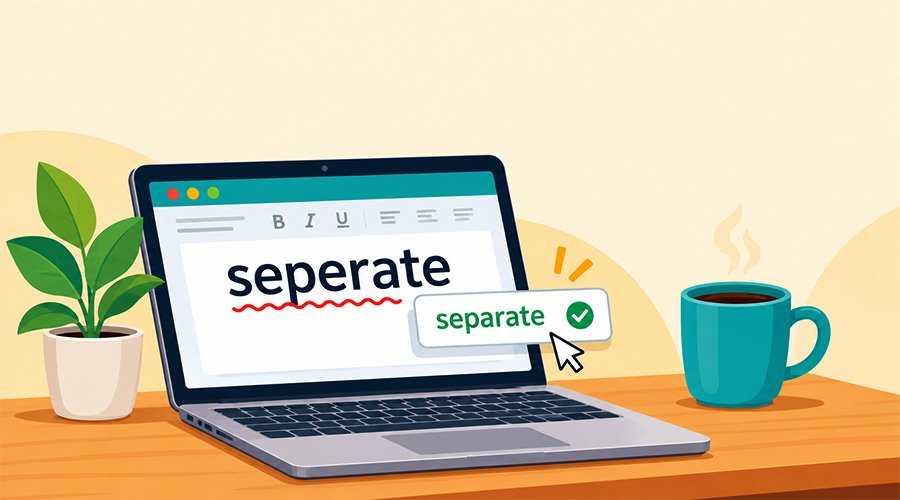
You are typing a quick email. You reach the word and freeze. Is it seperate or separate? Red lines may pop up, or they may not, and now you are second-guessing yourself.
You are not alone. This word trips up students, professionals, and even confident writers. The good news is that the answer is simple, and a few easy tricks can lock it into your memory. This guide covers the correct spelling, the reason the mistake is so common, and practical ways to get it right every time.
Seperate or Separate: The Quick Answer
The correct spelling is separate. It has an “a” in the middle, right after the first “p”. The version with an “e” in that spot, seperate, is a misspelling. Merriam-Webster lists only the form with an “a” and records no variant with an “e”.
So when you wonder about seperate or separate, remember this rule. Every time you write the word, the second syllable should be “par”, not “per”. Think of it as sep-a-rate.
This applies to British, American, Canadian, and Australian English alike. Some words change between regions, such as colour and color. This one does not. Everyone spells it the same way.
Why Do So Many People Write Seperate?
The mix-up between seperate or separate is understandable. English spelling does not always follow the sounds we hear. When you say the word aloud in casual speech, the middle vowel often turns into a soft, lazy sound. Linguists call it a schwa. It is the same unstressed sound you hear in the word “about”.
Because the sound is so weak, your brain has to guess which letter belongs there. Many words that sound similar use an “e” in that position. Words like “temperature” and “desperate” are good examples. Your mind quietly follows the pattern and picks the wrong letter.
Typing habits play a part too. Fast typists rely on muscle memory, and an error that is repeated often becomes a habit. Spell checkers catch it most of the time. Still, some tools ignore it when it sits inside a brand name, a username, or a hashtag.
Social media has also spread the error. When people see an error many times, it starts to look normal. Familiarity can fool the eye, even when the letters are wrong.
Where the Word Comes From
A little history makes the spelling easier to trust. The word comes from the Latin verb separare. It combines se, which means “apart”, with parare, which means “to prepare” or “to procure”. Put together, the idea is to set something apart from the rest. Merriam-Webster gives this same word history.
Notice the letters in that root. The Latin form has an “a” in the middle, and English kept it. The “par” part is the heart of the word. When you know the origin, the “a” stops feeling random.
English borrowed the word in the late Middle Ages. Over the centuries, the pronunciation softened. The spelling, however, stayed loyal to its Latin parent. That gap between sound and spelling is exactly where the confusion lives today.
Easy Tricks to Remember the Correct Spelling
Memory tricks work well for tricky words, and this one has a famous helper. There is a rat in sepa rate. Picture a small rat sitting in the middle of the word. It sounds silly, and that is exactly why it sticks.
Another option is to split the word into three chunks: sep, a, and rate. Say them slowly as you type, and the lone “a” in the middle will stand out. You can also pair it with “apart”. Both words describe things kept away from each other, and both carry that same letter.
Some writers prefer a sentence they can repeat. Try this one: “Please separate the apples and the rats.” It is odd, but odd sentences are easy to recall. Say it twice, and you will probably never hesitate again.
If visual memory is your strength, write the word on a sticky note and place it near your screen. After a week or two, your fingers will learn the right pattern on their own.
Separate as a Verb, an Adjective, and a Noun
Part of what makes this word interesting is that it plays more than one role. It also changes its pronunciation depending on the role. Understanding this can help you write it with more confidence.
As a verb, it means to divide or to pull things apart. The last syllable sounds like “ate”. For example, you might separate laundry by color, or separate egg whites from yolks. A teacher may separate two students who talk too much.
As an adjective, it means distinct, individual, or not joined. Here the last syllable sounds softer, more like “it”. You might say, “We booked separate rooms,” or “That is a separate issue.” The meaning is that the things are not connected.
As a noun, it is less common, but it exists. In fashion, “separates” are clothing pieces sold individually, such as a skirt or a jacket that you can mix and match. Retail writers use this form often.
Because the spelling is identical across all three roles, you only need to learn it once. Whether you meet it as an action, a description, or a clothing term, the letters stay the same.
The table below sums up the three roles side by side.
| Role | Meaning | Ending sound | Example |
| Verb | To divide or pull apart | Clear “ate” | Separate the files by year before you upload them. |
| Adjective | Distinct or not joined | Soft “it” | She keeps a separate account for travel savings. |
| Noun | A clothing piece sold on its own | Soft “it” | Her wardrobe is built around a few simple separates. |
Related Words You Should Spell Correctly Too
Once you master the base word, its family follows easily. The same “a” appears in every related form. That consistency works in your favor.
The adverb is “separately”, as in “The two teams worked separately.” The noun for the act of dividing is “separation”. Past and present forms are “separated” and “separating”. You will also see “separable”, which describes something that can be divided, and “inseparable”, which describes things that cannot be pulled apart, like close friends.
This table pairs each correct form with the error people often make.
| Correct form | Common misspelling | Part of speech |
| separately | seperately | Adverb |
| separation | seperation | Noun |
| separated | seperated | Verb or adjective |
| separating | seperating | Verb |
| separable | seperable | Adjective |
| inseparable | inseperable | Adjective |
Misspellings spread through the whole family when the base word is wrong. People who write seperate also tend to write “seperately” and “seperation”. Fix the root, and every cousin gets fixed automatically.
Common Usage Mistakes Beyond Spelling
The seperate or separate choice is only part of the picture. A few usage slips are worth knowing about, because they show up in professional writing all the time.
The verb usually pairs with the preposition “from”. You separate one thing from another. Writers sometimes use “separate to” or “separate with”, but those versions sound awkward. Stick with “from” and your sentence will read naturally.
Another slip involves the phrase “separate out”. Often the word “out” adds nothing. “Separate the data” says the same thing as “separate out the data”. Cutting the extra word makes your writing tighter.
People also confuse “separate” with “apart”. Apart describes position or distance, while separate describes a division or distinction. “The houses stand apart” talks about space. “The houses have separate owners” talks about ownership. Choosing the right one keeps your meaning clear.
Is Seperate Ever Acceptable?
Short answer: no. Some English words do have two valid spellings, like “judgment” and “judgement”. That is not the case here. Seperate is simply an error, and readers tend to notice it.
The debate over seperate or separate has a clear winner in standard references. Readers, editors, and teachers all expect the same form.
When you come across the spelling in older texts or informal posts, treat it as a slip rather than a variant. If you are editing someone else’s work, correct it quietly and move on.
Why Getting This Right Matters for Professional Writing
Think about where the seperate or separate choice matters. It shows up in contracts, product descriptions, job applications, school essays, and website copy. In each case, the writer wants to look capable and trustworthy.
For website owners, there is an extra angle. Search engines handle misspellings fairly well, but clean content still performs better with readers. People who land on a page full of typos tend to leave quickly. Good spelling supports a better reading experience and a stronger impression.
If you manage content for a team, add seperate or separate to your style checklist. A short list of commonly misspelled words saves editors a lot of time. It also helps new writers learn your standards faster.
Frequently Asked Questions
Is it seperate or separate?
The correct spelling is separate. Seperate is a common misspelling and does not appear as an accepted form in standard dictionaries.
What is the easiest way to remember how to spell separate?
Remember that there is “a rat” in sep-a-rat-e. This little image reminds you that the middle letter is “a” and not “e”.
Is separate spelled differently in British and American English?
No. Both varieties use the same spelling. Regional differences do not apply to this word.
How do you pronounce separate?
The pronunciation depends on the part of speech. As an adjective, it ends with a soft “it” sound. As a verb, it ends with a clear “ate” sound.
Why does spell check sometimes miss it?
Some tools skip words inside usernames, links, hashtags, or all-caps text. Others may be switched off or set to the wrong language. Always proofread important text yourself.
Final Thoughts on Seperate or Separate
So, seperate or separate? The answer is clear. Separate, with an “a” in the middle, is the only correct choice. The wrong version feels natural because the middle vowel is so faint when we speak, yet the Latin root tells us exactly which letter belongs there.
Keep the rat trick close, remember the “par” in the middle, and practice the word in a few real sentences. With a little repetition, the doubt will disappear. Next time you write about things that are apart, you can type the word quickly and move on with confidence.
Sources
Merriam-Webster. “Separate.” Merriam-Webster.com Dictionary. Used for the spelling, definitions, noun sense, pronunciation, and Latin word history.