
IDM Meaning in Text: The Three Letters That Hand You the Choice
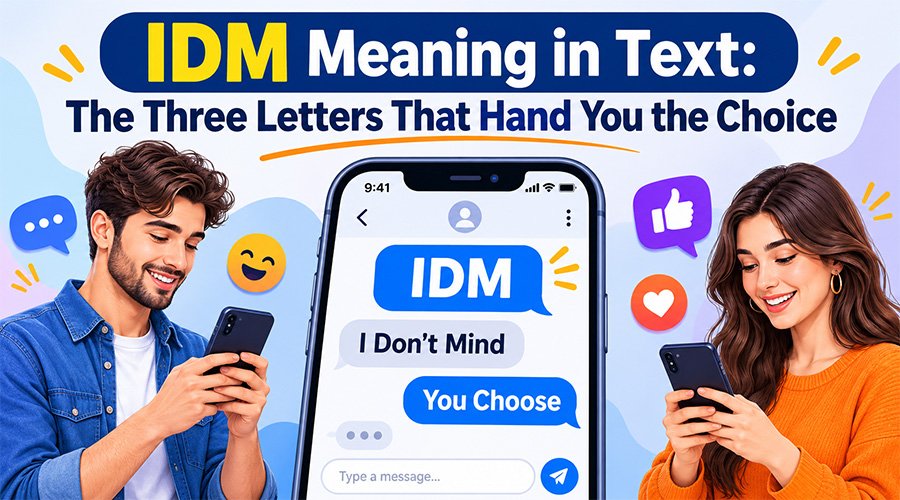
A three-letter reply can leave an entire conversation hanging, especially when you are expecting someone to make a clear choice. Imagine asking a friend whether they prefer Friday or Saturday, only to receive “IDM” as the answer. The usual idm meaning in text is “I Don’t Mind.”
It tells you that the sender has no strong preference and is comfortable with either option. Although the abbreviation is simple, its tone can change depending on the question, relationship, and situation.
What Does IDM Mean in Texting?
IDM stands for “I Don’t Mind.” It is an informal abbreviation used in digital conversations when someone has no objection to an idea, suggestion, or arrangement.
For example, imagine that a friend asks whether you want to watch a comedy or an action film. You have no particular preference, so you reply, “IDM, you choose.” This tells your friend that either option is acceptable.
Dictionary.com also recognizes IDM as a texting abbreviation for “I don’t mind.” Wiktionary lists it under internet slang and text messaging, with examples of its use in casual conversations.
In everyday messages, IDM can communicate a few related ideas:
- Either option is fine with me.
- I’m comfortable with your suggestion.
- I have no particular preference.
- You can make the final decision.
- That arrangement doesn’t bother me.
One distinction matters: having no objection does not necessarily mean being excited about something. Someone can accept a plan without considering it their first choice.
Real-Life Examples of IDM in Text Messages
The meaning becomes easier to understand when you see how the abbreviation works in different conversations. Its use is particularly common when friends or family members are making small decisions.
Here are some realistic examples:
Example 1: Choosing a Place to Eat
Friend: “Should we get burgers or pizza tonight?”
You: “IDM, both sound good.”
Meaning: You are happy with either meal.
Example 2: Changing an Appointment
Friend: “Can we move our meeting to Sunday?”
You: “IDM.”
Meaning: You have no objection to the new day.
Example 3: Making Weekend Plans
Friend: “Are you free on Saturday or Sunday?”
You: “IDM, whichever works for you.”
Meaning: You are letting your friend choose the date.
Example 4: Watching a Movie
Friend: “Do you want to watch a thriller or comedy?”
You: “IDM, pick something good.”
Meaning: You are comfortable with either genre.
Example 5: Group Plans
Friend: “Is everyone okay if we invite another person?”
You: “IDM.”
Meaning: You have no problem with the additional guest.
These situations show that IDM usually works as a response to a question. It is less useful when someone needs a detailed opinion or a definite commitment.
Does IDM Sound Rude or Friendly?
IDM is generally neutral rather than rude. However, short messages can sometimes feel cold because they do not communicate much emotion.
Consider these three situations:
| Message | Possible Impression |
| “IDM.” | Neutral and straightforward |
| “IDM, whatever you prefer!” | Friendly and flexible |
| “IDM, just decide.” | Casual, but potentially impatient |
The relationship between the sender and recipient also matters. Close friends may use short replies without expecting additional explanation. Someone discussing an important personal matter might interpret the same response as a lack of interest.
To avoid confusion, add a few words when you want to sound more considerate.
For instance, “I’m happy with either option” communicates the same general idea but feels more personal than a three-letter response.
IDM vs. IDK vs. IDC: What’s the Difference?
IDM, IDK, and IDC are three different abbreviations. Their similar appearance can cause confusion, especially when someone is unfamiliar with texting slang.
| Short Form | Full Meaning | How It Is Used |
| IDM | I Don’t Mind | You have no strong preference. |
| IDK | I Don’t Know | You are unsure or do not have an answer. |
| IDC | I Don’t Care | You are expressing indifference. |
| IMO | In My Opinion | You are sharing a personal viewpoint. |
| TBH | To Be Honest | You are introducing an honest opinion. |
| NVM | Never Mind | You are withdrawing or dismissing something. |
The difference between IDM and IDC deserves particular attention.
Suppose someone asks, “Where should we go for dinner?”
- IDM: Either restaurant is fine with you.
- IDK: You haven’t decided where to go.
- IDC: The destination does not matter to you, although the reply may sound dismissive.
IDM is usually the more cooperative response because it shows that you are willing to accommodate another person’s preference.
How to Reply When Someone Sends IDM
When someone uses this abbreviation, you can usually move the conversation forward by making the decision yourself.
The right response depends on what you were discussing.
| Their Message | Suggested Reply |
| “IDM.” | “Okay, let’s go with the first option.” |
| “IDM, you decide.” | “I’ll pick the restaurant, then.” |
| “IDM either day.” | “Saturday works better for me.” |
| “IDM if they come along.” | “Great, I’ll invite them.” |
| “IDM, whatever is easier.” | “Let’s keep the original plan.” |
You can also use these natural responses:
- “Sounds good to me.”
- “Perfect, I’ll arrange everything.”
- “Great, let’s do that.”
- “Okay, I’ll make the final choice.”
There is no need to overthink a casual response. However, when the decision involves money, travel, or an important commitment, confirm that the other person is genuinely comfortable with your choice.
Read Also: ALR Meaning in Text
When Should You Use IDM in a Conversation?
IDM works best when you genuinely have no objection to a suggestion. It keeps simple conversations moving without requiring a lengthy explanation.
Here are some situations where it makes sense:
- Choosing between options: A friend asks which café you prefer, but both are fine.
- Changing plans: Someone suggests a different meeting time that suits your schedule.
- Accepting an invitation: You are comfortable with the proposed activity.
- Making group decisions: You have no objection to someone else’s suggestion.
- Giving someone control: You are happy to let another person make the final choice.
However, there are situations where using an abbreviation is not appropriate.
For example, replying “IDM” to a manager who asks whether you can complete an important assignment by Monday may leave your availability unclear. A better response would be, “Yes, Monday works for me.”
The same applies to professional emails, formal discussions, and serious personal conversations. Complete sentences make your position easier to understand.
Other Meanings of IDM
Although “I Don’t Mind” is a common meaning in casual messages, IDM can refer to completely different things in other fields.
The subject of a conversation helps determine which definition makes sense.
| Context | Meaning | Explanation |
| Text messaging | I Don’t Mind | An informal response showing flexibility. |
| Electronic music | Intelligent Dance Music | A style of experimental electronic music. |
| Computer software | Internet Download Manager | Software used to manage and accelerate file downloads. |
| Technology | Identity Management (IdM) | A field concerned with managing digital identities. |
These alternative meanings have established uses beyond everyday messaging.
IDM in Electronic Music
AllMusic describes IDM (Intelligent Dance Music) as a form of experimental electronic music that developed from several dance and electronic styles.
IDM in Download Software
The official Internet Download Manager website describes IDM as software for managing downloads, including pausing, resuming, and scheduling them.
Identity Management: A Related Technical Term
In identity and access management, the abbreviation is not simply “IDM.” NIST lists IAM, IdAM, and IDAM as abbreviations or synonyms for Identity and Access Management. This is a related technical field, but it should not be presented as another standard expansion of the texting abbreviation.
Frequently Asked Questions
1. What does IDM mean in text from a girl or guy?
IDM generally means “I Don’t Mind,” regardless of who sends it. It does not automatically indicate romantic interest, disappointment, or rejection. The surrounding conversation provides more useful clues about the person’s intention.
2. Does IDM mean yes?
Not exactly. IDM usually indicates that someone accepts a suggestion or has no objection. It can function as agreement, but it does not necessarily show enthusiasm or confirm every detail of a plan.
3. Does IDM mean “It Doesn’t Matter”?
The established texting expansion discussed here is “I Don’t Mind.” Some abbreviation references also list “It Doesn’t Matter” as an alternative interpretation. However, the surrounding message should determine which meaning makes sense.
4. Is IDM the same as whatever?
No. IDM usually communicates flexibility, while “whatever” can sound dismissive or impatient. For example, “IDM, you choose” sounds accommodating, whereas “Whatever, do what you want” may suggest frustration.
5. Can I use IDM in professional messages?
It is better to use complete sentences in professional communication. Expressions such as “I have no preference” or “Either option works for me” sound clearer and more appropriate in business discussions.
6. What is the difference between IDM and IM?
IDM means “I Don’t Mind,” while IM commonly stands for “Instant Message” or “Instant Messaging.” Their meanings depend on the context, but they are not interchangeable.
Final Thoughts
Understanding the idm meaning in text makes everyday digital conversations easier to follow. In most casual messages, it stands for “I Don’t Mind” and indicates that someone is comfortable with a suggestion or has no strong preference.
It is a simple way to express flexibility without writing a complete sentence. Just remember that IDM is different from IDK and IDC, and its tone depends on the situation. When a decision is important, a clear response is always better than leaving the other person guessing.
Editorial sources
These are the references used for the factual explanations in the article:
- Dictionary.com – IDM meaning and texting usage — Texting definition and usage example.
- Wiktionary – IDM — Internet slang and text-messaging classification.
- AllMusic – IDM Music Style — Intelligent Dance Music.
- Internet Download Manager – Official About Page — Software definition and functionality.
- NIST – Identity and Access Management Glossary — Official technical terminology.


One Comment