
YWA Meaning: The Hidden Tone Behind This Text Reply
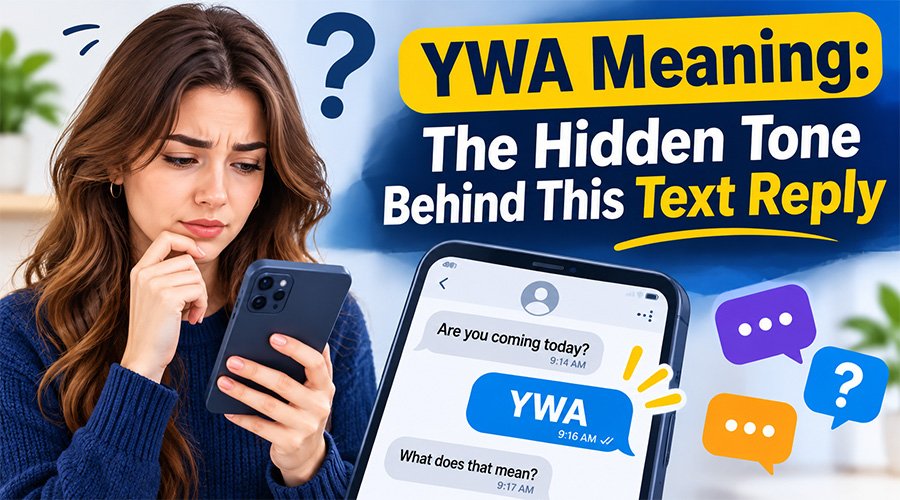
Imagine answering someone’s question, only to hear, “That’s not what I asked!” You spent time trying to help, but your response missed the point. Instead of arguing, you reply with three letters: “YWA.” This small abbreviation carries more attitude than a regular thank-you response. The YWA meaning is “You’re Welcome Anyway.”
It is an informal expression used when someone has offered help, shared information, or answered a question but did not quite give the other person what they wanted.
Unlike “YW,” which simply means “You’re Welcome,” YWA can have a sarcastic or slightly cheeky edge. It sometimes suggests that the sender deserves appreciation despite the disappointing response or lack of acknowledgment.
The expression is mostly suited to casual conversations between friends and acquaintances. Understanding the situation behind it makes a big difference when interpreting the sender’s intention.
What Does YWA Mean in a Text Message?
YWA stands for “You’re Welcome Anyway.” It is a short expression used when someone wants to acknowledge their own effort, even when their help was not exactly what another person needed.
The abbreviation is particularly associated with situations where someone answers a question but misses the point. The sender may use it to imply that their effort still deserves recognition.
Consider this conversation:
Example:
- Alex: Do you know when the shopping mall closes?
- Ryan: It opens at 10 in the morning.
- Alex: I asked when it closes.
- Ryan: Oh, sorry. It closes at 9 PM.
- Alex: Thanks.
- Ryan: YWA!
Ryan uses the abbreviation as a slightly cheeky response. He provided information, even though his first answer did not address the actual question.
According to Slang.net, this abbreviation has a somewhat snarky quality because it assumes appreciation even when the original response was not particularly helpful.
Depending on the relationship and circumstances, YWA can communicate different attitudes:
- Sarcasm: A reminder that the sender made an effort.
- Playfulness: Friendly teasing between people who know each other.
- Mild frustration: A reaction when someone’s contribution goes unnoticed.
- Lighthearted acknowledgment: A casual response when help was appreciated despite an imperfect outcome.
It is important not to interpret every use as an insult. The preceding messages usually provide the clearest indication of the intended tone.
When Do People Use YWA?
YWA is most suitable for situations where someone wants to highlight their effort without turning a minor interaction into a serious disagreement.
Here are four examples that show how it works in everyday conversations.
1. When Someone Gives an Unhelpful Answer
A person may ask for specific information but receive an answer that does not address their question. The person who responded might use YWA to point out that they still tried to help.
Example:
- Mia: Do you know the price of that phone?
- Emma: It has a really good camera.
- Mia: I was asking about the price.
- Emma: Well, YWA!
Emma’s response adds a little sarcasm because her first answer was not useful.
2. When Your Recommendation Is Rejected
You might recommend a movie, restaurant, or product to someone. If they dismiss your suggestion, YWA can become a playful response.
Example:
- Jack: You should watch that new action movie.
- Noah: I don’t really enjoy action movies.
- Jack: YWA. I was just making a suggestion!
Here, Jack is lightly defending his recommendation rather than expressing serious disappointment.
3. When Someone Ignores Your Contribution
Sometimes, a friend overlooks information or assistance you have already provided.
Example:
- Sarah: I sent you the location yesterday.
- Lily: Can you send me the address again?
- Sarah: I already did, but YWA!
Sarah is pointing out that she previously helped, even though the other person did not notice.
4. When Friends Are Having a Sarcastic Exchange
Close friends often tease each other without intending to cause offence.
Example:
- Ben: I recommended three restaurants for dinner.
- Chris: None of them looks interesting.
- Ben: Well, YWA 😂
The laughing emoji makes the reply feel less serious.
YWA Meaning: Realistic Texting Examples
The following table summarizes common situations in which someone might use this abbreviation.
| Situation | Example response | Intended tone |
| An answer misses the question | “Well, YWA!” | Sarcastic |
| A recommendation gets rejected | “YWA 😂” | Playful |
| Help goes unnoticed | “I tried, YWA.” | Mild frustration |
| Friends tease each other | “YWA anyway!” | Humorous |
| An imperfect suggestion is acknowledged | “YWA, no problem.” | Casual |
These examples illustrate possible uses rather than fixed rules. Someone’s usual communication style can change how the same message sounds.
Does YWA Mean Something Different on Snapchat, Instagram, and WhatsApp?
No separate standard definition is established for each platform. YWA generally retains its “You’re Welcome Anyway” interpretation across messaging services.
However, the way people use it can vary with the conversation.
Snapchat: You may see it in direct messages or group chats when friends exchange jokes or react to suggestions. A message such as “YWA 😂” can be a playful response after someone dismisses a recommendation.
Instagram: In direct messages, the abbreviation can appear after someone shares information or offers advice. It can also work as a sarcastic reply when the other person does not appreciate the contribution.
WhatsApp: Friends may use YWA in private conversations or group chats when someone has answered a question or tried to help.
The platform itself does not determine the meaning. The previous messages and the sender’s intention are more useful clues.
What Is the Difference Between YWA, YW, and NP?
YWA is easy to confuse with other abbreviations because several expressions are used when responding to thanks or acknowledging help.
However, they communicate slightly different ideas.
| Abbreviation | Full meaning | Main purpose |
| YWA | You’re Welcome Anyway | Acknowledges an effort, sometimes sarcastically |
| YW | You’re Welcome | Responds to someone’s appreciation |
| NP | No Problem | Shows that helping was not an inconvenience |
| NW | No Worries | Reassures another person |
| TY | Thank You | Expresses gratitude |
| TYSM | Thank You So Much | Shows extra appreciation |
For example, someone who receives a thank-you message after sharing a document can simply reply with YW.
NP is more suitable when someone apologizes for asking a favor. YWA is different because it can suggest that the sender tried to help even when the contribution was not fully appreciated.
How Should You Reply When Someone Sends YWA?
Your response should depend on the situation rather than the abbreviation alone. A friendly message usually deserves a friendly response, while a slightly frustrated message may need a more thoughtful answer.
Here are some replies that work in different circumstances:
- “Thanks anyway!” – When someone’s suggestion was not useful but you appreciate the effort.
- “Haha, I appreciate it.” – When the sender is joking.
- “Sorry, I misunderstood your help.” – When you overlooked their contribution.
- “I know, thanks for trying.” – When their effort did not produce the expected result.
- “You’re the best!” – When you want to express genuine appreciation.
- “I owe you one!” – When someone has made an effort to help.
You do not need to match sarcasm with sarcasm. A simple acknowledgment is often enough to keep the conversation comfortable.
Is YWA Rude or Passive-Aggressive?
YWA is not automatically rude, but it can sound passive-aggressive in certain situations.
For example, imagine giving someone directions and receiving a complaint because the information was not accurate. Replying with “YWA” might suggest that you expected appreciation despite the mistake.
The message can also feel harmless between close friends who regularly tease each other.
Before deciding how someone intended it, consider these points:
- The relationship: A close friend may use sarcasm that would seem inappropriate from a stranger.
- The previous exchange: An argument can make a short response sound more negative.
- The wording: “YWA 😂” may feel playful, while “YWA, I guess” can suggest disappointment.
- The situation: Someone who has genuinely tried to help may simply be defending their effort.
If the message feels uncomfortable, asking what the person meant is better than assuming they are angry.
When Should You Avoid Using YWA?
Although YWA can work in casual chats, it is not appropriate for every conversation.
Using it with someone who does not understand the abbreviation may create confusion. In professional settings, its sarcastic undertone can also make a normal exchange sound unnecessarily confrontational.
Avoid using it in:
- Business emails and client communications.
- Formal discussions with managers or colleagues.
- Serious conversations involving personal problems.
- Customer support messages.
- Conversations with people who are unfamiliar with texting slang.
A complete response such as “You’re welcome” or “Happy to help” is clearer in these situations.
Frequently Asked Questions
1. What does YWA mean in texting?
YWA means “You’re Welcome Anyway.” It is an informal expression used when someone has tried to help or answer a question but has not necessarily given the other person what they wanted.
2. Is YWA the same as YW?
No. YW stands for “You’re Welcome,” while YWA means “You’re Welcome Anyway.” The additional word can give the latter a more sarcastic or playful tone.
3. Does YWA mean someone is annoyed?
Not always. It can express mild frustration, but friends also use it for teasing and humor. The surrounding conversation helps reveal the sender’s mood.
4. What should I reply to YWA?
You can respond with “Thanks anyway,” “I appreciate your help,” or “Haha, thanks!” Choose a response that matches the original conversation.
5. Can YWA be used in professional messages?
It is better to avoid it in professional communication because the expression can sound sarcastic. A straightforward “You’re welcome” is more suitable.
6. Is YWA a popular texting abbreviation?
YWA is a documented texting abbreviation, but it is not as universally familiar as LOL, BRB, or IDK. Some readers may need context to understand it.
7. What does the A stand for in YWA?
The final A stands for “Anyway.” It changes the expression from the straightforward “You’re Welcome” to “You’re Welcome Anyway.”
Final Thoughts
A response does not always need a full sentence to express an attitude. YWA is a good example of how three letters can communicate both appreciation and a little sarcasm.
The YWA meaning is “You’re Welcome Anyway.” It is generally used when someone has offered information, answered a question, or made an effort that was not fully appreciated or did not meet expectations.
When you receive this abbreviation, pay attention to what happened before it appeared. That context will help you decide whether the sender is joking, being sarcastic, or simply acknowledging the conversation.

One Comment