
Simple Predicate Grammar Made Easy: Examples and Tips
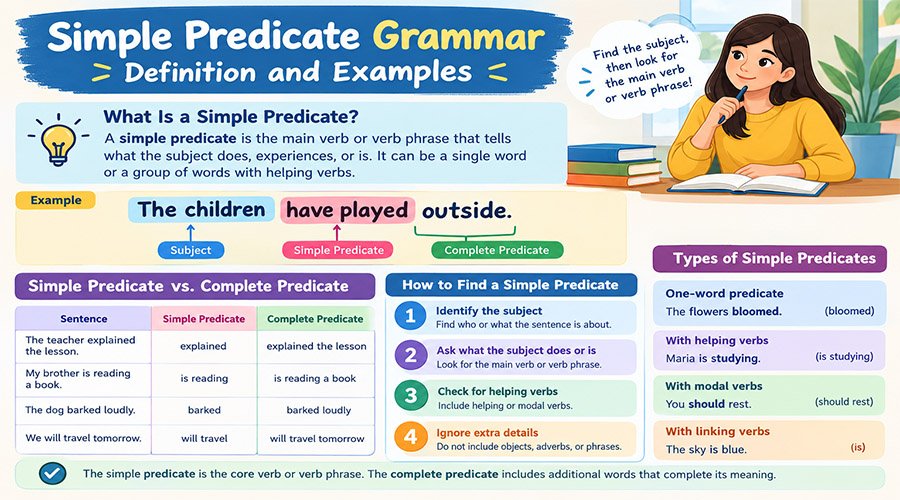
Understanding simple predicate grammar is an important part of learning how English sentences work. A sentence typically consists of a subject and a predicate.
The subject identifies who or what the sentence is about, while the predicate explains what the subject does, what happens to it, or what it is.
The primary verb or verb phrase in the predicate is known as the simple predicate. It may be a single word, such as laughed, or several words, such as has finished.
Knowing how to spot it helps you better understand how sentences are built and prevents you from making typical grammar errors.
What Is a Simple Predicate in Grammar?
A simple predicate is the main verb or verb phrase that tells what the subject does, experiences, or is. It shows the main action, situation, or state that the sentence is talking about.
For example:
The children played outside.
- Subject: The children
- Simple predicate: played
The word played tells us what the children did, so it is the simple predicate.
A simple predicate can also contain helping verbs:
The children have played outside.
Here, have played is the simple predicate. Played is the primary verb, and have is a supporting verb.
The simple predicate does not include all the words that come after the subject. It focuses on the central verb or verb phrase.
Simple Predicate vs. Complete Predicate
A simple predicate and a complete predicate are connected, but they refer to different parts of a sentence.
The simple predicate contains the main verb or verb phrase. The complete predicate includes the simple predicate plus the words that provide additional information about the action or state.
Consider this example:
The young student completed the difficult assignment quickly.
| Part | Example |
| Subject | The young student |
| Simple predicate | completed |
| Complete predicate | completed the difficult assignment quickly |
The word completed is the simple predicate. The remaining words explain what was completed and how the action happened.
Another example:
My brother is watching a movie in his room.
The simple predicate is is watching, while the complete predicate is is watching a movie in his room.
A useful way to remember the difference is that the simple predicate is the core verb, while the complete predicate is the entire predicate section.
How to Find a Simple Predicate
Finding a simple predicate becomes easier when you use a consistent method.
1. Find the Subject
First, figure out who or what the sentence is talking about.
The old car needs repairs.
The subject is The old car.
2. Ask What the Subject Does or Is
Next, identify the main action or state.
What does the old car do?
It needs repairs.
Therefore, needs is the simple predicate.
3. Look for Helping Verbs
If a helping verb is used with the main verb, include it in the simple predicate.
Sarah has finished her homework.
The simple predicate is has finished.
Similarly:
They will arrive tomorrow.
The simple predicate is will arrive.
4. Leave Out Extra Information
Do not automatically include objects, adverbs, or prepositional phrases.
The athlete ran quickly across the field.
The simple predicate is ran.
Quickly explains how the athlete ran, while across the field tells where the action occurred.
Simple Predicate Examples
Simple predicates can appear in many different sentence structures.
One-Word Predicates
The baby cried.
Simple predicate: cried
The flowers bloomed beautifully.
Simple predicate: bloomed
James opened the door.
Simple predicate: opened
In these sentences, one main verb expresses what the subject does.
Predicates With Helping Verbs
Maria is studying for her exam.
Simple predicate: is studying
The players were practicing yesterday.
Simple predicate: were practicing
David has completed the project.
Simple predicate: has completed
The helping verbs form part of the verb phrase and should not be separated from the main verb when identifying the simple predicate.
Predicates With Linking Verbs
A simple predicate does not always describe an action. It can also contain a linking verb that connects the subject with information describing or identifying it.
The soup is hot.
Simple predicate: is
Michael became a doctor.
Simple predicate: became
In these examples, the verbs show a condition or relationship instead of a real physical action.
Simple Predicate and Compound Predicate
A compound predicate contains two or more verbs or verb phrases connected to the same subject.
For example:
Emma washed the dishes and cleaned the kitchen.
The subject is Emma, while the verbs washed and cleaned form a compound predicate.
Compare it with:
Emma washed the dishes.
Here, washed is the simple predicate because there is only one main verb.
Another example:
The dog barked and ran toward the gate.
The subject is the dog, and the two actions are barked and ran.
It is important not to confuse a compound predicate with a longer verb phrase. In “She has been working,” the words has been working form one verb phrase, so they function together as the simple predicate.
Common Mistakes When Identifying a Simple Predicate
One common mistake is including the object with the verb.
David kicked the ball.
The simple predicate is kicked, not kicked the ball. The phrase the ball is the direct object.
Another mistake is leaving out helping verbs.
The students are studying English.
The simple predicate is are studying, not just studying.
Students may also mistake an adverb for part of the predicate:
The bird flew quickly.
The simple predicate is flew. The word quickly describes how the bird flew.
Finally, do not assume that a predicate must describe a physical action. Linking verbs can also function as simple predicates:
The room became quiet.
The simple predicate is became.
Why Is the Simple Predicate Important?
Recognizing the simple predicate helps you understand the basic structure of English sentences. It also provides a foundation for learning more advanced grammar concepts.
Once you can identify the main verb, it becomes easier to study:
- Verb tenses
- Subject-verb agreement
- Helping verbs
- Linking verbs
- Direct objects
- Compound predicates
- Sentence structure
For example, identifying has completed in The student has completed the assignment helps you recognize both the verb phrase and its tense.
Frequently Asked Questions
What is a simple predicate in grammar?
A simple predicate is the main verb or verb phrase that tells what the subject does, experiences, or is. For example, “The dog barked” has barked as its simple predicate.
Can a simple predicate have more than one word?
Yes. Helping and modal verbs can be included. In “They will travel tomorrow,” the simple predicate is will travel.
What is the difference between a simple and complete predicate?
The simple predicate has the main verb or verb phrase. The complete predicate includes that verb along with other words that help explain or change its meaning.
What is an example of a compound predicate?
In “Lisa cooked dinner and washed the dishes,” cooked and washed form a compound predicate because they describe two actions performed by the same subject.
Can a linking verb be a simple predicate?
Yes. In “The weather is cold,” the simple predicate is is. The linking verb connects the subject with information describing it.
Final Takeaway
Simple predicate grammar focuses on one of the most important parts of sentence structure: the main verb or verb phrase. To identify it, first find the subject and then determine what that subject does, experiences, or is.
Remember that helping verbs can form part of the simple predicate, while objects and modifiers generally belong to the wider complete predicate. With a little practice, recognizing simple predicates becomes a straightforward way to understand how English sentences are built.