What Is 20% of 50? Here’s the Calculation Explained
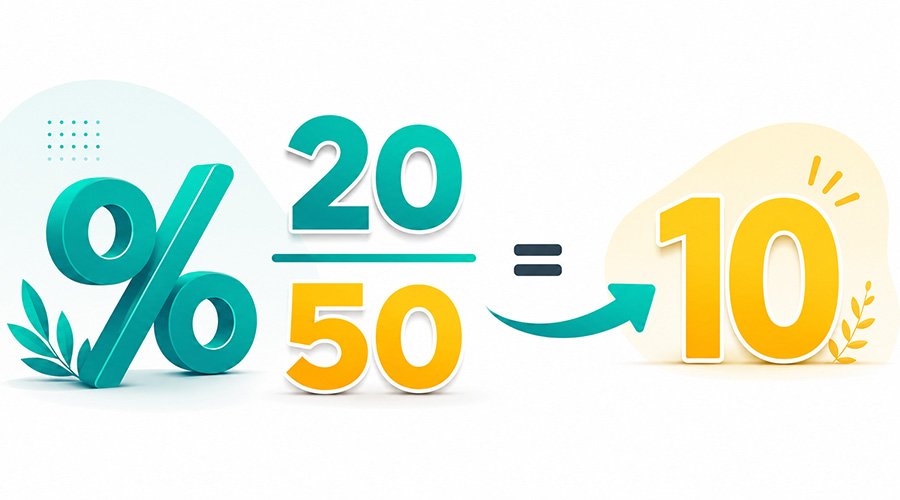
20% of 50 is 10. This comes from multiplying 50 by 0.20, which equals 10. It is one of the most common percentage calculations people search for, whether the context is a discount, a test score, or a quick budgeting check.
Students often run into this exact calculation when scoring a 50-question test, since missing 20% of the questions means missing 10 of them. The math behind it is simple once broken down into a repeatable formula, and the same steps work for any percentage of any number.
The Simple Formula
Finding a percentage of a number always follows the same basic formula.
Percentage of a number = (Percentage ÷ 100) × Number
Applied here: (20 ÷ 100) × 50 = 0.20 × 50 = 10.
Three Ways to Reach the Same Answer
Reaching the number 10 is possible through a few different approaches. Each method suits a different situation, depending on whether you have a calculator handy or need a quick mental estimate.
| Method | How It Works | Result |
| Decimal multiplication | Convert 20% to 0.20, then multiply by 50 | 10 |
| Fraction method | Simplify 20% to 1/5, then divide 50 by 5 | 10 |
| Tenths method | Split 50 into 10 equal parts of 5, then take 2 parts for 20% | 10 |
The tenths method is often the fastest for mental math. Splitting a number into 10 equal parts gives you 10% right away, since each part is one-tenth of the total. From there, 20% just means taking two of those parts instead of one. This works well for any percentage that is a clean multiple of 10.
Real-World Examples of 20% Calculations
Percentage calculations show up constantly in everyday situations, not just math problems.
- Shopping discounts: A $50 item with a 20% discount saves $10, bringing the price down to $40.
- Tipping: A 20% tip on a $50 restaurant bill comes to $10.
- Savings goals: Setting aside 20% of a $50 paycheck means saving $10.
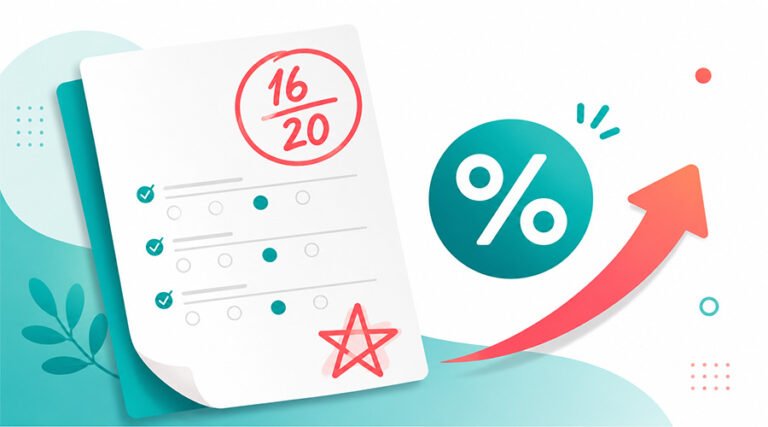
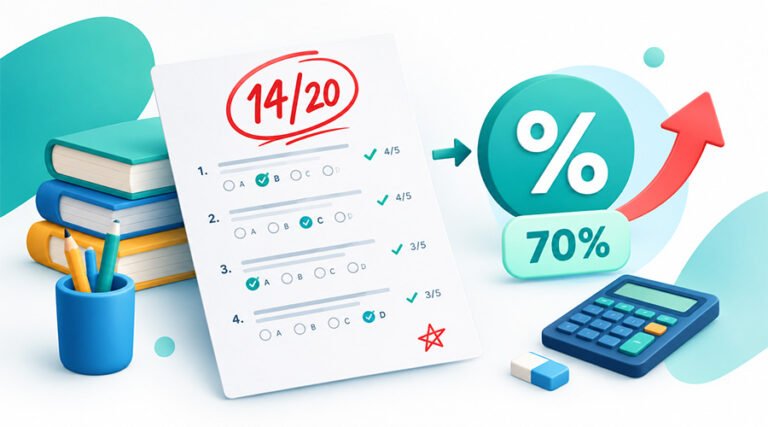
- Test scores: On a 50-question test, missing 20% of the questions means missing 10 of them, which brings the score down to 40 out of 50, or 80%.
The math stays identical across all of these situations. Only the context changes.
For the test score example specifically, the calculation can also run in reverse. If a student misses 10 out of 50 questions, dividing 10 by 50 gives 0.20, or 20%. That confirms the two directions match: 20% of 50 is 10, and 10 out of 50 is 20%.
How to Find the Percentage the Other Way
Sometimes the question flips. Instead of finding 20% of 50, you might need to know what percentage 10 is of 50.
The formula for this direction is different:
Percentage = (Part ÷ Whole) × 100
Using the same numbers: (10 ÷ 50) × 100 = 0.20 × 100 = 20%.
This confirms the relationship works both ways. 20% of 50 is 10, and 10 is 20% of 50.
Common Mistakes When Calculating Percentages
A few errors show up often, especially when doing percentage math quickly or by hand.
- Forgetting to convert the percentage to a decimal first. Multiplying 50 by 20 instead of 0.20 gives 1,000, which is far too large and a common slip when rushing.
- Mixing up the “of” direction. “20% of 50” and “50% of 20” happen to produce the same answer here, but that is not true for most number pairs, so it helps to double check which number is the whole and which is the percentage.
- Rounding too early in multi-step problems. If a calculation involves several percentage steps, rounding in the middle can shift the final answer. It is safer to keep full decimals until the very last step.
- Confusing percentage increase with the percentage itself. Finding 20% of 50 is different from increasing 50 by 20%. The first gives 10, while the second gives 60, since it adds the 20% on top of the original number.
How This Changes With Different Numbers
The same method applies no matter which numbers are involved. Seeing a few more examples side by side makes the pattern easier to spot.
| Calculation | Formula | Result |
| 20% of 50 | 50 × 0.20 | 10 |
| 20% of 100 | 100 × 0.20 | 20 |
| 20% of 200 | 200 × 0.20 | 40 |
| 20% of 25 | 25 × 0.20 | 5 |
Notice that the percentage stays fixed at 20% in every row, while the result scales directly with the number. Doubling the starting number always doubles the result, since the relationship is proportional.
Why Percentage Increase Is a Different Calculation
It is worth separating “20% of 50” from “50 increased by 20%,” since students often mix these up on tests.
Finding 20% of 50 answers the question: what is one-fifth of 50? The answer is 10.
Increasing 50 by 20% answers a different question: what is 50 plus an extra 20% on top? That calculation looks like this: 50 + (50 × 0.20) = 50 + 10 = 60.
Both calculations use the same 20% and the same starting number, but they answer different questions and produce different results.
Frequently Asked Questions
What is 20% of 50 as a fraction?
20% of 50 equals 10, which can also be written as the fraction 10/50, simplified to 1/5.
How do you find 20% of any number quickly?
Divide the number by 5, since 20% is equal to one-fifth of any total.
How do you work out a percentage of a given number?
Take the percentage, divide it by 100, and multiply that result by the number in question.
Does 20% of 50 give the same result as 50% of 20?
Yes, both calculations equal 10, since multiplication works the same in either order.
What is 20% of 50 in decimal form?
20% converts to 0.20 as a decimal, and 0.20 multiplied by 50 equals 10.
Need to calculate a different percentage or figure out your grade based on questions missed? Try the free calculators on GradesCalculator.net to get instant, accurate results.